%20--%3e%3cpath%20d='M451.7,65.6v29.2h33.3c-2.8,4.2-11.2,7.9-26.3,7.9s-29.8-8.2-29.8-27.3,10.5-27.3,30.1-27.3,25.5,6.8,25.5,12.1h58v-4.2c0-30-17.2-40-48.4-40h-66.3c-34,0-56.7,14-56.7,51.4v15.4c0,37.8,21.2,51.4,53.5,51.4h28.1c18.5,0,29-6.5,34.8-15.2v14h55.8v-67.2h-91.5Z'/%3e%3cpath%20d='M550.2,15.9v36h55.8v44.1h-55.8v36.3h169.9v-36.3h-56v-44.1h56V15.9h-169.9Z'/%3e%3cpath%20d='M727.1,15.9v116.5h169.4v-34h-111.5v-6.5h110.4v-35.3h-110.4v-7h111.5V15.9h-169.4Z'/%3e%3cpath%20d='M903.4,15.9v36.8h55.8v79.7h58.1V52.8h56V15.9h-169.9Z'/%3e%3cpath%20d='M245.4,138.1h68.1c30,0,50.5-14.9,50.5-46.4V19.9h-54.3v52.6c0,18.5-8.8,28.6-29.1,28.6s-28.6-10.1-28.6-28.6V19.9h-58.1v71.7c0,31.5,21.2,46.4,51.3,46.4Z'/%3e%3cpath%20d='M16.6,15.9v117h58v-34.2h41.2c11.5,0,16.3,3.1,16.3,15.9v18.4h54.3v-28c0-14.6-8.6-20.5-20.8-22.2,12.5-2.6,21.5-11.4,21.5-26.6v-6.7c0-21.6-9.4-33.4-39.4-33.4H16.6ZM118.9,50.6c9.7,0,13.5,2,13.5,7.2s-3.8,7.2-13.5,7.2h-44.2v-14.3h44.2Z'/%3e%3c/svg%3e)

What Is DHT and How Does It Cause Hair Loss?
DHT is the hormone responsible for male pattern baldness in genetically susceptible men. Here's what it is, how it damages hair follicles, and what treatments block it.
If you've looked into why men go bald, you've likely encountered the acronym DHT. It appears in nearly every discussion of male pattern hair loss — and for good reason. DHT is the primary hormonal driver of androgenetic alopecia, the most common form of hair loss in men. Understanding what DHT is, how it affects hair follicles, and what can be done to block it is essential context for any man researching treatment options.
What Is DHT?
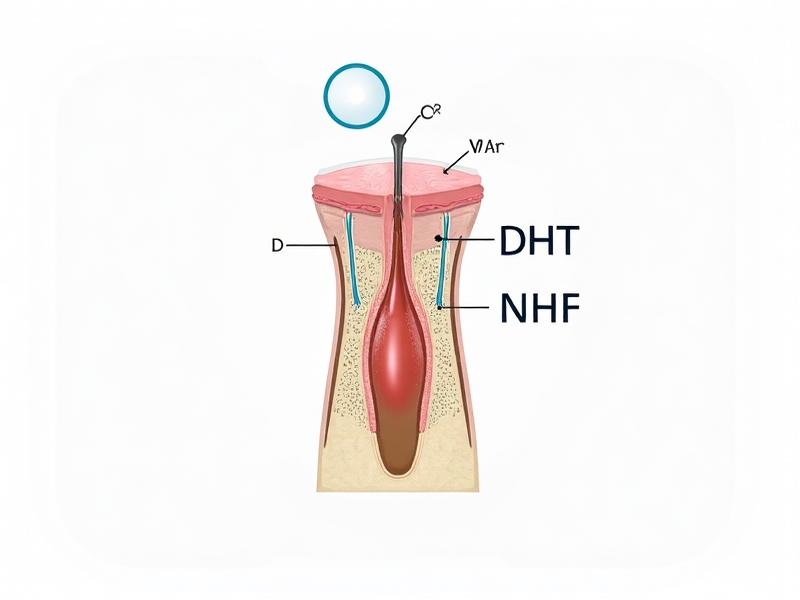
DHT stands for dihydrotestosterone. It is an androgen — a male sex hormone — derived from testosterone. The conversion happens when an enzyme called 5-alpha reductase, found in the oil glands of hair follicles, acts on circulating testosterone. DHT is more potent than testosterone itself: it binds more tightly to androgen receptors throughout the body and produces stronger androgenic effects.
DHT serves important functions. During puberty, it contributes to the development of male secondary sex characteristics. In adulthood, it plays a role in prostate function. However, in men with a genetic predisposition to male pattern baldness, DHT also has a destructive effect on scalp hair follicles.
How DHT Causes Hair Loss
The critical factor in male pattern hair loss is not how much DHT a man produces, but whether his hair follicles are genetically sensitive to it. In men with androgenetic alopecia, DHT binds to receptors in scalp follicles and triggers a process called miniaturization. Affected follicles progressively shrink, producing thinner and shorter strands with each hair cycle. Eventually, the follicle may stop producing visible hair altogether.
More than 95% of hair loss in men is attributed to androgenetic alopecia. The characteristic pattern — receding hairline, thinning at the crown, eventual broader loss across the top of the scalp — reflects where DHT-sensitive follicles are concentrated. Follicles at the back and sides of the scalp are typically resistant to DHT, which is why hair in those areas tends to persist even in men with significant hair loss elsewhere.
The Role of 5-Alpha Reductase
Because 5-alpha reductase is the enzyme that produces DHT, it is the primary target for pharmacological treatment of male pattern hair loss. Finasteride works by competitively inhibiting 5-alpha reductase types II and III, reducing DHT levels in the scalp. Finasteride 1mg daily reduces scalp DHT levels by approximately 64–69%.
When DHT is reduced, the miniaturization process slows or stops. In large-scale clinical trials, 83% of men treated with finasteride showed no further hair loss at two years, compared to 28% of men receiving placebo. Hair count improvement was observed in 66% of finasteride-treated men at two years, compared to 7% of placebo recipients.
Do Natural DHT Blockers Work?
A number of supplements and topical ingredients are marketed as natural DHT blockers — including saw palmetto, pumpkin seed oil, green tea extract, and various herbal formulations. These products are common in shampoos, vitamins, and sprays aimed at hair loss.
The clinical evidence for natural DHT blockers is limited and inconsistent. Some small studies suggest saw palmetto may have a modest inhibitory effect on 5-alpha reductase, but the data does not approach the level of evidence supporting finasteride. Biotin is often included in hair loss supplements and does support general hair structure, but it does not block DHT and has not been shown to reverse androgenetic alopecia in men who are not biotin-deficient.
Ketoconazole, an antifungal ingredient found in some medicated shampoos, has demonstrated mild anti-androgenic properties in some research and is sometimes used as a supportive measure alongside proven treatments. It is not a standalone treatment for male pattern hair loss.
For men experiencing DHT-driven hair loss, finasteride remains the most clinically validated pharmacological option for blocking DHT at its source.
Does DHT Affect the Entire Scalp?
No. DHT sensitivity in hair follicles is not uniform across the scalp. Follicles in the frontal hairline and at the vertex (crown) are the most susceptible. Finasteride is most effective at the crown but has also been shown to reduce hair loss in other areas of the scalp.
Follicles at the back and sides of the scalp — the donor zone used in hair transplant procedures — are largely DHT-resistant. This is why hair in those areas persists in men with advanced androgenetic alopecia.
When Should Men Consider DHT-Blocking Treatment?
Hair loss from androgenetic alopecia is progressive — it does not stabilize or reverse without treatment. Follicles in the early stages of miniaturization are more responsive to DHT-blocking treatment than those that have been inactive for years. Men who notice early signs of thinning or a receding hairline are generally better candidates for treatment than those who wait until significant hair loss has already occurred.
A licensed healthcare provider can assess the pattern and extent of hair loss and advise on appropriate treatment options.
Ready to treat your hair loss?
🔥 Get 15% off RUGIET with code EMH15🔥 15% off RUGIET: EMH15